Generation Alpha Paradigm Shift Part 3: The Climate We Created

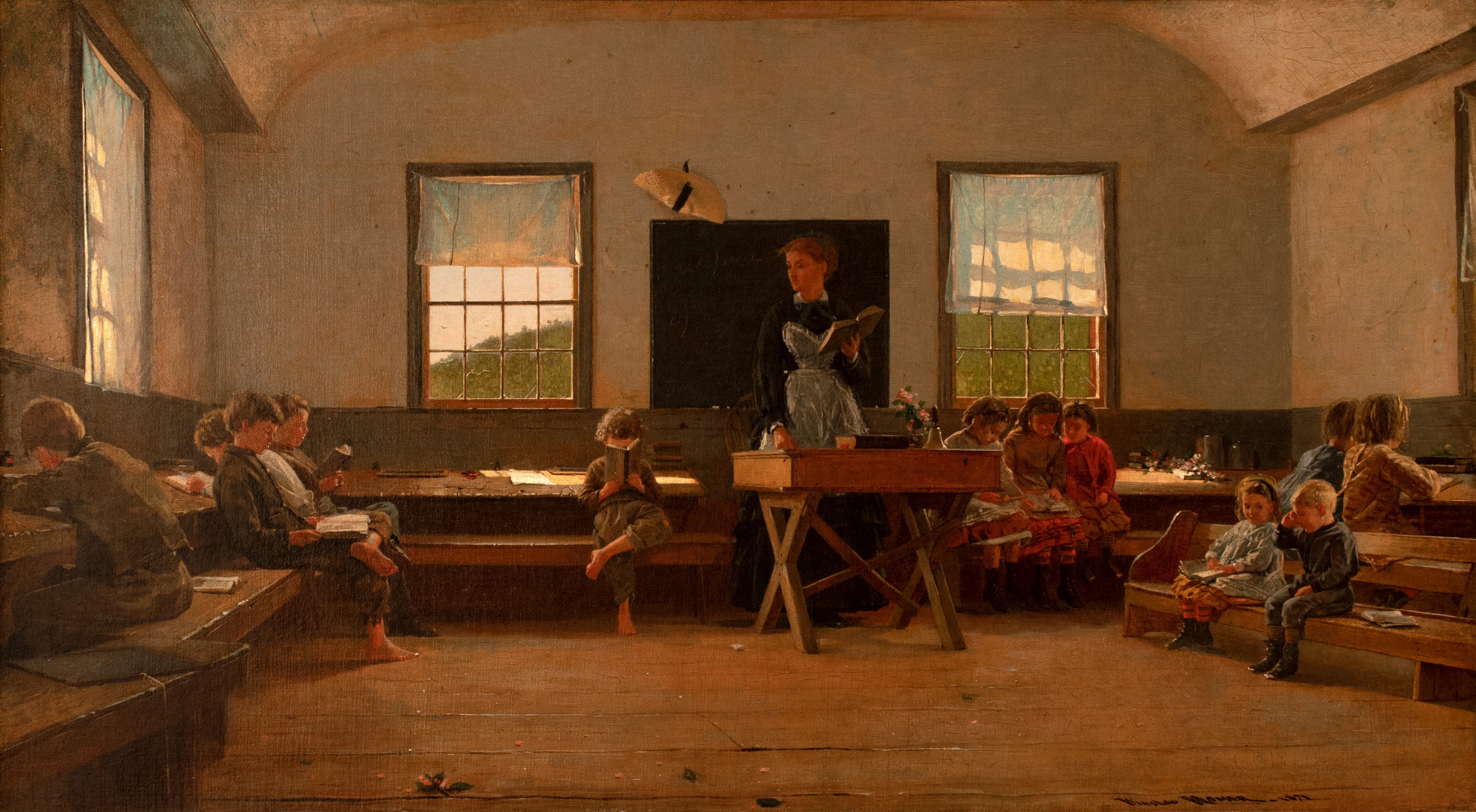
The Country School by Winslow Homer, 1871
In 1852, Massachusetts passed the nation’s first compulsory education law. At the time, the compulsory angle of public schooling was a totally novel concept. Less than a decade before, the father of public education, Horace Mann, had traveled to Prussia. Mann had sought a system of civilian management, saw the Prussians’ mass public school obedience as a model, and was immediately persuaded. Upon his return to the United States, he introduced the concept of state funded, compulsory schooling to his state. Massachusetts adopted the country’s first state board of education in 1837 and less than 20 years later, it was compulsory.
This process was tedious, but achieved because of a general fear of and subsequent desire to culturally assimilate immigrants, the influx of Catholicism, a desire to increase literacy across poor communities, and a growing disapproval of child labor in factories. To its credit, early public education initiatives achieved a radical restructuring of society, changing the paradigm for education forever.
In 1870, Mississippi’s first public education legislation was passed. It outlined regional school districts and instituted superintendents to carry out duties of the system, but compulsory attendance? Absent.
Finally, in 1918, Mississippi passed what was by then the last compulsory public school attendance law by state in the United States. This milestone was the start of a new chapter in this country’s education system.
How did Mississippi manage for so long? Was compulsory attendance a feature or an unavoidable bureaucratic procedure? How did it impact the strength and legitimacy of the public education system nationwide?
Compulsory attendance has been a touchstone of the evolution of American public schooling ever since that fateful year of 1918. From this point of national crystallization, it has been the catalyst for a national education identity, standards, a teachers union, and foundation of the U.S. Department of Education in 1979. Compulsory attendance legislation was not a trivial afterthought. Neither was it seen as an overt disenfranchisement of citizen’s rights. Rather, it was a calculated, systematic intention to align how the country went about literally and figuratively managing its citizens.
The Climate We Created
In this third installment of the Generation Alpha Paradigm Shift, I intend to explore this and other angles to understand why we got here.
What has mass compulsory education wrought?
Who has actually benefitted?
Why are we still prescribing to this system?
If there is a change on the horizon, when will we see it?
What Has Mass Compulsory Education Wrought?
Educational attainment has been analyzed by the National Center for Education Statistics. In 120 Years of American Education: A Statistical Portrait , the following is said:
The increasing rates of school attendance have been reflected in rising proportions of adults completing high school and college. Progressively fewer adults have limited their education to completion of the 8th grade which was typical in the early part of the century. In 1940, more than half of the U.S. population had completed no more than an eighth grade education. Only 6 percent of males and 4 percent of females had completed 4 years of college. The median years of school attained by the adult population, 25 years old and over, had registered only a scant rise from 8.1 to 8.6 years over a 30 year period from 1910 to 1940.
During the 1940s and 1950s, the more highly educated younger cohorts began to make their mark on the average for the entire adult population. More than half of the young adults of the 1940s and 1950s completed high school and the median educational attainment of 25- to 29-years-olds rose to 12 years. By 1960, 42 percent of males, 25 years old and over, still had completed no more than the eighth grade, but 40 percent had completed high school and 10 percent had completed 4 years of college. The corresponding proportion for women completing high school was about the same, but the proportion completing college was somewhat lower.
In the 2021-22 school year, High School diplomas - the pinnacle achievement of public education- were handed out to some 87% of the class. This number, as claimed here, is 7 points higher than a decade earlier (side note: though ostensibly positive, the how and why for this stat is not clearly explained).
From these citations, you’ll notice compulsion did not guarantee immediate widespread attendance. Though high school became normalized in the late 1910s, its completion rates took decades to achieve significance. The culture of compulsory education in America, it turns out, was unnatural. When an entire generation (the so-called Silent Generation) was in its infancy, it was made the experimental tool of the newly comprehensive education managerial standard. Public reticence toward this new standard was felt most acutely in this era. However, by 1940, the technological landscape of the economy quickly subsumed the following generation- the Baby Boomers- into a total normalization of compulsory public schooling nationwide.
In addition to slow generational adoption, that early stage of nationwide compulsory schooling contended with different states in the union holding different markers, resources, and population characteristics. How a state managed its education system often directly correlated to its political, bureaucratic, and cultural influence upon the power players of early 20th century America. Where money and politics were dominate (New England, California, and the industrial hubs of Chicago and Michigan), compulsory education was quickly adopted.
The first 10 states to pass compulsory education laws were:
Massachusetts -1852
Vermont - 1867
District of Columbia - 1864
New Jersey - 1871
Michigan - 1871
Connecticut - 1872
New York - 1874
California - 1874
Wisconsin = 1879
Illinois - 1883
It is no coincidence that a city like Lowell, Massachusetts -arguably the nation’s first industrial hub- sat adjacent to the highest concentration of higher-education institutions per capita in the US - Boston. Education in this state was used from the onset to directly influence cultural and social life in its urban populations. That influence was immediately felt in surrounding New England and other industrialized cities like Philadelphia, where much of the tone was set for the rest of the country.
States with burgeoning industrial economies gained significantly more from compulsory education over states that remained agricultural. After all, the industrial state populations needed to be primed for factory work. When the South was defeated in the Civil War, this industrial system spread into Southern states via the auspices of Reconstruction.
It took an awkward interval of 66 years, but eventually all states embraced compulsory education- even in the south.
So what did we get out of it? Has the unification of the country under the banner of forced attendance created a high functioning society? Inarguably, yes. Has that high functioning society empowered large swaths of the population? Superficially, yes. Most critically of all, have higher rates of compulsive schooling and subsequent graduation produced a more productive, better educated society?
The long answer is: in certain capacities, yes.
The short answer? No. Not even close.
What is the high school graduate in 2026 compared to 1955?
How does a high school graduate positively impact his/her economy in 2026 compared to 1955?
What has become of the High School Diploma? Does it even mean anything anymore?
In short, a diploma signals credential completion, not knowledge, skill, or judgement. The rest of the answers correspond to:
dramatic shifts in credential signaling
an increasingly stagnate ability for public school to pivot in direct response to demands of the economy
decreasing emphasis on creative problem solving, cross-disciplinary thinking, self-direction, and group work
lower standards for competency across the board
routine standardization of curriculum
bureaucratization of education and its compounding effects on society
teaching to tests
etc.
If you have working experience within the public education system, you likely understand the structure is deeply flawed. You may not have the full picture, but with enough experience you understand simple problems devolve into years long conundrums. Even the most optimistic participants eventually submit to this reality.
How the high school diploma’s reputation cratered in a little over 50 years is not the result of accelerating literacy, reading comprehension, or generic competency as mapped by testing scores. Quite the contrary. Since 1971, those metrics have either been flat, or are slowly on the decline.
Instead, innovation in the economy has run circles around what the compulsory education model can offer. Over and over, we see it outpacing anything that can be projected by a guaranteed standard of a uniformed citizenry. Slowly but surely, that standard is updated, but with years -sometimes decades- of delay. What the diploma used to represent was baseline competency for the workforce. Now, it’s barely a reliable marker.
As college attendance achieves historic highs, our population appears more incompetent than ever. Modern teachers are sounding the alarm on how impossible the coming generations are to teach. Reading for pleasure is at an all time low. Basic problem solving skills are being sacrificed for easier, pacifying acts of a rampant, be-with-you-at-all-times service economy. Dramatic stunting of soft skills like collaboration and communication have befallen Gen Z and Generation Alpha as they enter the workforce.
No. Compulsory attendance has not given us a boon of diversified, self-applying, highly competent individuals. If anything it has promulgated a great decline of all three. What we are seeing as a direct result of compulsive, one-size-fits-all curricula is a decline in standards across the board. Our priors sowed the seeds. Now we reap.
Who has actually benefitted?
We must be fair and apply nuance to the question. We cannot judge a moving target, nor can we ascertain the success of a system that seems to assert itself in bigger and bolder ways each decade of its existence. But, in light of this, we can analyze nearly 200 years and deduce a basic reality: the last beneficiaries of the system are its students.
In its compulsion, the American public school experiment brought manipulation, coercion, and propaganda in the fold of goodness and pure intentions. Not because it was conscious of doing so, but because it was immediately overcome by the cosmic law of force. That force is compulsion.
Government-led schooling is a machine and it’s gears are bureaucracy
For the structure of any mass system to work, adherence to standards must be met. How and why those standards are imposed is not a student led proposition. It never has been. How can a system of compulsion seek the desires of the compelled? Saying “you must listen to me!” is not the same as “what drives you?”. The two statements exist in completely opposite worlds. The system of compulsion must operate as intended. It must manage in order to educate.
For reasons that are both fair and foul — but mostly for fair reasons — we have come under the domain of a scientific-management system whose ambitions are endless. They want to manage every second of our lives, every expenditure that we make. And the schools are the training ground to create a population that’s easy to manage.
John Taylor Gatto, legendary advocate for learners worldwide, is attributed this quote. Through 30 years of teaching in New York City public schools, Gatto came to see a radical reinterpretation of what the system was actually doing: scientific management.
So who benefits? For this system, the managers. The agents who unwittingly contribute to a massive act of compliance, millions of dollars and students deep, lost in its increasing irrelevance, steeped in its overbearing bureaucracy.
Why are we still prescribing to this system?
The modern myth of America is its active defiance in the face of unruly authority. Our most famous and enduring historical portraits present this fervor to hundreds of thousands of school children every year. But how that sentiment persists in the midst of the 21st century is befuddling.
The Constitution, once a hallmark of citizen empowerment, now presents as a shell of platitudes in light of the seemingly endless emergency powers government has bestowed upon itself since the start of the 21st century. The most illuminating case happening 20 years in:
The CDC, state health departments, and the president of the American Federation of Teachers, Randi Weingarten, held America’s children hostage for nearly a year and a half in 2020-2021. Claiming numerous times to prioritize safe reopening of schools even after most business sectors had fully reopened (you know, the same ones teachers and students alike were actively participating in as everyday citizens). These health agencies and Weingarten leaned heavily on the potential threats of the pandemic to justify keeping students out of in-person learning. The consequence? Thousands of children’s developmental years interrupted and turned into a live lab experiment.
In that critical time, virtual learning became the de facto alternative. Its results presented everything wrong with the system:
dramatic declines in test scores and eventual interest in learning
negative impacts on mental health and anxiety
deterioration of critical language processing for early learners
This was the result of a system beholden by a structure of coercion. Its steadfast determination to make school attendance mandatory ended up contributing to its beautifully ironic unraveling. During that same time period, private schools reopened faster or were never fully closed at all.
What the current government-led model presumes is authority, but it operates almost exclusively off inertia. Examples from the pandemic showcase how even it wanted to prioritize in-person learning, the bureaucracy wouldn’t let it.
And guess who suffered the greatest consequences? That’s right, the group the entire system is predicated on serving: the children.
If there is a change on the horizon, when will we see it?
If there is a change, we will only see it because we want to see it. We will only see it when we recognize the reality of the system as it operates and start to fight back in earnest. Ironically, reactions to how the system handled the pandemic pushed many parents into homeschooling. Many woke up to the realities of a system too inefficient, too captured by bureaucracy, and too big to turn around.
Generation Alpha and the System
Current generations in the system must be understood with the above framework in mind. Generation Alpha has entered public school amidst decades of objective failure. Compulsion and it’s beneficiaries are in no position to adjust. This is how inertia works.
But we don’t need to wallow in doom and gloom. We can take stock in observing and calling out the system for its problems. We can elect to get our children out of it. We can supplement our children’s wellbeing with conscious intervention. The climate society created doesn’t have to define another generation. Its time for a paradigm shift.
If you enjoyed this, stay tuned for The Generation Alpha Paradigm Shift: Part 4. I hope to expand into deeper analysis and invoke compelling arguments for why we are poised to not only witness this paradigm shift, but promote it with all our being.
Also, consider joining Art Explorers Club
We are an online community of parents passionate about the creative futures of our children.